AI/ML
Agent Skills
Production-grade engineering skills for AI coding agents.
npx skills add addyosmani/agent-skillsSkill 详情
Agent Skills
Production-grade engineering skills for AI coding agents.
Skills encode the workflows, quality gates, and best practices that senior engineers use when building software. These ones are packaged so AI agents follow them consistently across every phase of development.
<a href="https://trendshift.io/repositories/25200" target="_blank"><img src="https://trendshift.io/api/badge/repositories/25200" alt="addyosmani%2Fagent-skills | Trendshift" style="width: 250px; height: 55px;" width="250" height="55"/></a>
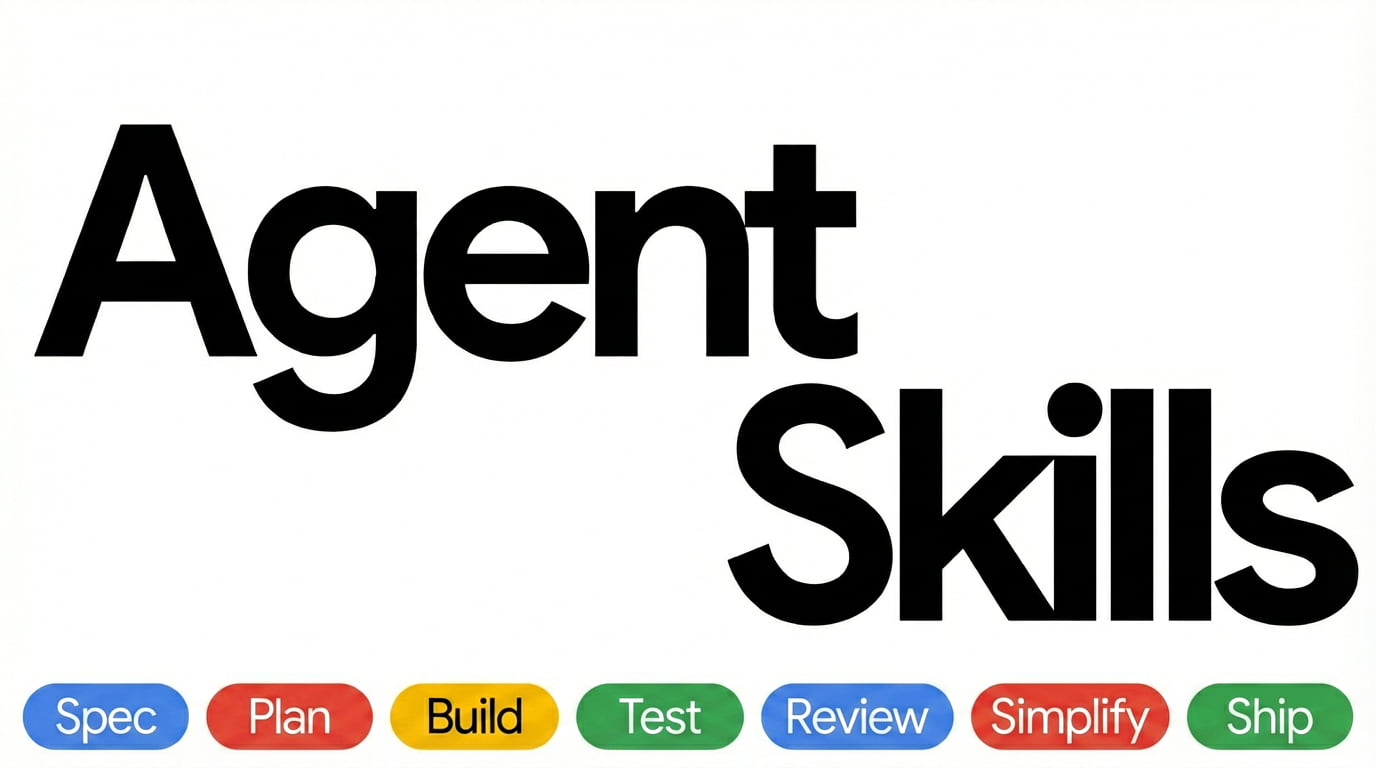
  DEFINE          PLAN           BUILD          VERIFY         REVIEW          SHIP
 ┌──────┐      ┌──────┐      ┌──────┐      ┌──────┐      ┌──────┐      ┌──────┐
 │ Idea │ ───▶ │ Spec │ ───▶ │ Code │ ───▶ │ Test │ ───▶ │  QA  │ ───▶ │  Go  │
 │Refine│      │  PRD │      │ Impl │      │Debug │      │ Gate │      │ Live │
 └──────┘      └──────┘      └──────┘      └──────┘      └──────┘      └──────┘
  /spec          /plan          /build        /test         /review       /ship
Commands
9 slash commands that map to the development lifecycle. Each one activates the right skills automatically.
| What you're doing | Command | Key principle |
|---|---|---|
| Define what to build | /spec | Spec before code |
| Plan how to build it | /plan | Small, atomic tasks |
| Build incrementally | /build | One slice at a time |
| Prove it works | /test | Tests are proof |
| Set the quality bar | /constraints | Decide it once, enforce it everywhere |
| Review before merge | /review | Improve code health |
| Audit web performance | /webperf | Measure before you optimize |
| Simplify the code | /code-simplify | Clarity over cleverness |
| Ship to production | /ship | Faster is safer |
Want fewer manual steps once the spec exists? /build auto generates the plan and implements every task in a single approved pass — you approve the plan once, then it runs autonomously. It removes the human stepping between tasks, not the verification: every task is still test-driven and committed individually, and it pauses on failures or risky steps.
Skills also activate automatically based on what you're doing — designing an API triggers api-and-interface-design, building UI triggers frontend-ui-engineering, and so on.
Quick Start
Fastest path — any agent, one command. The open skills CLI installs into 70+ agents (Claude Code, Cursor, Codex, Copilot, Cline, and more):
npx skills add addyosmani/agent-skills            # install all 25 skills
npx skills add addyosmani/agent-skills --list     # browse before installing
Or grab individual skills:
npx skills add addyosmani/agent-skills --skill code-review-and-quality   # five-axis review before merge
npx skills add addyosmani/agent-skills --skill interview-me              # requirements interrogation, one question at a time
npx skills add addyosmani/agent-skills --skill test-driven-development   # red-green-refactor, enforced
Installing one skill? A per-skill
npxinstall copies onlyskills/<name>/, not the repo-levelreferences/directory. The skill still works, but paths to supplementary shared checklists are unavailable. Use a whole-repo integration, clone the repository, or copy the needed checklist into areferences/directory inside the installed skill. This portability gap is tracked in #361.
Prefer a native integration? Pick your tool below.
<details> <summary><b>Claude Code (recommended)</b></summary>Marketplace install:
/plugin marketplace add addyosmani/agent-skills
/plugin install agent-skills@addy-agent-skills
SSH errors? The marketplace clones repos via SSH. If you don't have SSH keys set up on GitHub, either add your SSH key or use the full HTTPS URL to force HTTPS cloning during the marketplace-add step:
/plugin marketplace add https://github.com/addyosmani/agent-skills.git
/plugin install agent-skills@addy-agent-skills
If
/plugin installstill fails withgit@github.com: Permission denied (publickey)on Windows or macOS, the recommended workaround is to configure Git once to rewrite GitHub SSH URLs to HTTPS for subprocess clones:git config --global url."https://github.com/".insteadOf git@github.com:
Local / development:
git clone https://github.com/addyosmani/agent-skills.git
claude --plugin-dir /path/to/agent-skills
Put workflow skills under .cursor/skills/ (sync from agent-skills/skills/) and short policies in .cursor/rules/*.mdc — do not paste full skills into rules. See docs/cursor-setup.md.
Install as a native plugin for skills, subagents, and slash commands. See docs/antigravity-setup.md.
Install from the repo:
agy plugin install https://github.com/addyosmani/agent-skills.git
Install from a local clone:
git clone https://github.com/addyosmani/agent-skills.git
agy plugin install ./agent-skills
Install as native skills for auto-discovery, or add to GEMINI.md for persistent context. See docs/gemini-cli-setup.md.
Install from the repo:
gemini skills install https://github.com/addyosmani/agent-skills.git --path skills
Install from a local clone:
gemini skills install ./agent-skills/skills/
Add skill contents to your Windsurf rules configuration. See docs/windsurf-setup.md.
</details> <details> <summary><b>OpenCode</b></summary>Copy skills to .opencode/skills/ (or ~/.config/opencode/skills/), add a project-local AGENTS.md, and use the built-in skill tool for agent-driven execution. Optional slash commands can be added under .opencode/commands/.
Use agent definitions from agents/ as Copilot personas and skill content in .github/copilot-instructions.md. See docs/copilot-setup.md.
Install as a native Codex plugin (Codex CLI v0.122+):
codex plugin marketplace add addyosmani/agent-skills
codex plugin add agent-skills@agent-skills
The first command registers the marketplace; the second installs the plugin. Codex reads the root skills/ directory directly through .codex-plugin/plugin.json. Once installed, invoke skills in chat using @ (e.g., @spec-driven-development). See docs/codex-setup.md for local installation and troubleshooting.
Install natively with the built-in cmd skills command. Command Code clones the repo, discovers every SKILL.md, and installs into .commandcode/skills/:
cmd skills add addyosmani/agent-skills            # pick skills to install (project)
cmd skills add addyosmani/agent-skills --global   # install for all projects (~/.commandcode/skills/)
cmd skills add addyosmani/agent-skills -s spec-driven-development  # install a specific skill
Installed skills show up in the TUI slash menu, e.g. /spec-driven-development. See docs/commandcode-setup.md.
Skills are plain Markdown - they work with any agent that accepts system prompts or instruction files. See docs/getting-started.md.
</details>Adoption
Already installed? How you roll the pack out depends on your codebase. The Adoption Guide covers two paths: the full lifecycle from day one for a greenfield project, or an incremental, verification-first rollout for an established codebase.
All 24 Skills
The commands above are entry points. The pack includes 25 skills total — 24 lifecycle skills plus the using-agent-skills meta-skill. Each skill is a structured workflow with steps, verification gates, and anti-rationalization tables. You can also reference any skill directly.
Meta - Discover which skill applies
| Skill | What It Does | Use When |
|---|---|---|
| using-agent-skills | Maps incoming work to the right skill workflow and defines shared operating rules | Starting a session or deciding which skill applies |
Define - Clarify what to build
| Skill | What It Does | Use When |
|---|---|---|
| interview-me | One-question-at-a-time interview that extracts what the user actually wants instead of what they think they should want, until ~95% confidence | The ask is underspecified, or the user invokes "interview me" / "grill me" |
| idea-refine | Structured divergent/convergent thinking to turn vague ideas into concrete proposals | You have a rough concept that needs exploration |
| spec-driven-development | Write a PRD covering objectives, commands, structure, code style, testing, and boundaries before any code | Starting a new project, feature, or significant change |
| constraint-driven-development | Interviews you for a quality bar with sane default thresholds, writes CONSTRAINTS.md, places each check by cost, and catches agents silencing checks or skipping tests to get green | No standards are written down, or an agent is producing more than anyone reads |
Plan - Break it down
| Skill | What It Does | Use When |
|---|---|---|
| planning-and-task-breakdown | Decompose specs into small, verifiable tasks with acceptance criteria and dependency ordering | You have a spec and need implementable units |
Build - Write the code
| Skill | What It Does | Use When |
|---|---|---|
| incremental-implementation | Thin vertical slices - implement, test, verify, commit. Feature flags, safe defaults, rollback-friendly changes | Any change touching more than one file |
| test-driven-development | Red-Green-Refactor, test pyramid (80/15/5), test sizes, DAMP over DRY, Beyonce Rule, browser testing | Implementing logic, fixing bugs, or changing behavior |
| context-engineering | Feed agents the right information at the right time - rules files, context packing, MCP integrations | Starting a session, switching tasks, or when output quality drops |
| source-driven-development | Ground every framework decision in official documentation - verify, cite sources, flag what's unverified | You want authoritative, source-cited code for any framework or library |
| doubt-driven-development | Adversarial fresh-context review of every non-trivial decision in-flight - CLAIM → EXTRACT → DOUBT → RECONCILE → STOP, with optional user-authorized cross-model escalation | Stakes are high (production, security, irreversible), working in unfamiliar code, or a confident output is cheaper to verify now than to debug later |
| frontend-ui-engineering | Component architecture, design systems, state management, responsive design, WCAG 2.1 AA accessibility | Building or modifying user-facing interfaces |
| api-and-interface-design | Contract-first design, Hyrum's Law, One-Version Rule, error semantics, boundary validation | Designing APIs, module boundaries, or public interfaces |
Verify - Prove it works
| Skill | What It Does | Use When |
|---|---|---|
| browser-testing-with-devtools | Chrome DevTools MCP for live runtime data - DOM inspection, console logs, network traces, performance profiling | Building or debugging anything that runs in a browser |
| debugging-and-error-recovery | Five-step triage: reproduce, localize, reduce, fix, guard. Stop-the-line rule, safe fallbacks | Tests fail, builds break, or behavior is unexpected |
Review - Quality gates before merge
| Skill | What It Does | Use When |
|---|---|---|
| code-review-and-quality | Five-axis review, change sizing (~100 lines), severity labels (Nit/Optional/FYI), review speed norms, splitting strategies | Before merging any change |
| code-simplification | Chesterton's Fence, Rule of 500, reduce complexity while preserving exact behavior | Code works but is harder to read or maintain than it should be |
| security-and-hardening | OWASP Top 10 prevention, auth patterns, secrets management, dependency auditing, three-tier boundary system | Handling user input, auth, data storage, or external integrations |
| performance-optimization | Measure-first approach - Core Web Vitals targets, profiling workflows, bundle analysis, anti-pattern detection | Performance requirements exist or you suspect regressions |
Ship - Deploy with confidence
| Skill | What It Does | Use When |
|---|---|---|
| git-workflow-and-versioning | Trunk-based development, atomic commits, change sizing (~100 lines), the commit-as-save-point pattern | Making any code change (always) |
| ci-cd-and-automation | Shift Left, Faster is Safer, feature flags, quality gate pipelines, failure feedback loops | Setting up or modifying build and deploy pipelines |
| deprecation-and-migration | Code-as-liability mindset, compulsory vs advisory deprecation, migration patterns, zombie code removal | Removing old systems, migrating users, or sunsetting features |
| documentation-and-adrs | Architecture Decision Records, API docs, inline documentation standards - document the why | Making architectural decisions, changing APIs, or shipping features |
| observability-and-instrumentation | Structured logging, RED metrics, OpenTelemetry tracing, symptom-based alerting - instrument as you build | Adding telemetry, or shipping anything that runs in production |
| shipping-and-launch | Pre-launch checklists, feature flag lifecycle, staged rollouts, rollback procedures, monitoring setup | Preparing to deploy to production |
Agent Personas
Pre-configured specialist personas for targeted reviews:
| Agent | Role | Perspective |
|---|---|---|
| code-reviewer | Senior Staff Engineer | Five-axis code review with "would a staff engineer approve this?" standard |
| test-engineer | QA Specialist | Test strategy, coverage analysis, and the Prove-It pattern |
| security-auditor | Security Engineer | Vulnerability detection, threat modeling, OWASP assessment |
| web-performance-auditor | Web Performance Engineer | Core Web Vitals audit with Quick/Deep modes and a metric-honesty rule; run it via /webperf |
See docs/agents.md for the decision matrix, orchestration rules, and how personas compose with skills and slash commands.
Reference Checklists
Quick-reference material that skills pull in when needed:
| Reference | Covers |
|---|---|
| definition-of-done.md | Project-wide standing bar every change clears, contrasted with per-task acceptance criteria |
| testing-patterns.md | Test structure, naming, mocking, React/API/E2E examples, anti-patterns (JavaScript/TypeScript) |
| security-checklist.md | Pre-commit checks, auth, input validation, headers, CORS, OWASP Top 10 |
| performance-checklist.md | Core Web Vitals targets, frontend/backend checklists, measurement commands |
| accessibility-checklist.md | Keyboard nav, screen readers, visual design, ARIA, testing tools |
| observability-checklist.md | On-call questions, structured logging, RED/USE metrics, tracing, symptom-based alerting, pre-launch gate |
| orchestration-patterns.md | Endorsed multi-persona orchestration patterns, anti-patterns, and the "personas don't invoke personas" rule |
How Skills Work
Every skill follows a consistent anatomy:
┌─────────────────────────────────────────────────┐
│  SKILL.md                                       │
│                                                 │
│  ┌─ Frontmatter ─────────────────────────────┐  │
│  │ name: lowercase-hyphen-name               │  │
│  │ description: Guides agents through [task].│  │
│  │              Use when…                    │  │
│  └───────────────────────────────────────────┘  │
│  Overview         → What this skill does        │
│  When to Use      → Triggering conditions       │
│  Process          → Step-by-step workflow       │
│  Rationalizations → Excuses + rebuttals         │
│  Red Flags        → Signs something's wrong     │
│  Verification     → Evidence requirements       │
└─────────────────────────────────────────────────┘
Key design choices:
- Process, not prose. Skills are workflows agents follow, not reference docs they read. Each has steps, checkpoints, and exit criteria.
- Anti-rationalization. Every skill includes a table of common excuses agents use to skip steps (e.g., "I'll add tests later") with documented counter-arguments.
- Verification is non-negotiable. Every skill ends with evidence requirements - tests passing, build output, runtime data. "Seems right" is never sufficient.
- Progressive disclosure. The
SKILL.mdis the entry point. Supporting references load only when needed, keeping token usage minimal.
Project Structure
agent-skills/
├── skills/                            # 25 skills (24 lifecycle + 1 meta)
│   ├── interview-me/                  #   Define
│   ├── idea-refine/                   #   Define
│   ├── spec-driven-development/       #   Define
│   ├── constraint-driven-development/ #   Define
│   ├── planning-and-task-breakdown/   #   Plan
│   ├── incremental-implementation/    #   Build
│   ├── context-engineering/           #   Build
│   ├── source-driven-development/     #   Build
│   ├── doubt-driven-development/      #   Build
│   ├── frontend-ui-engineering/       #   Build
│   ├── test-driven-development/       #   Build
│   ├── api-and-interface-design/      #   Build
│   ├── browser-testing-with-devtools/ #   Verify
│   ├── debugging-and-error-recovery/  #   Verify
│   ├── code-review-and-quality/       #   Review
│   ├── code-simplification/           #   Review
│   ├── security-and-hardening/        #   Review
│   ├── performance-optimization/      #   Review
│   ├── git-workflow-and-versioning/   #   Ship
│   ├── ci-cd-and-automation/          #   Ship
│   ├── deprecation-and-migration/     #   Ship
│   ├── documentation-and-adrs/        #   Ship
│   ├── observability-and-instrumentation/ # Ship
│   ├── shipping-and-launch/           #   Ship
│   └── using-agent-skills/            #   Meta: how to use this pack
├── agents/                            # 4 specialist personas
├── references/                        # 7 supplementary checklists
├── hooks/                             # Session lifecycle hooks
├── .claude/commands/                  # 8 slash commands (Claude Code)
├── .gemini/commands/                  # 8 slash commands (Gemini CLI)
├── commands/                          # 8 slash commands (Antigravity CLI)
├── plugin.json                        # Antigravity plugin manifest
└── docs/                              # Setup guides per tool
Why Agent Skills?
AI coding agents default to the shortest path - which often means skipping specs, tests, security reviews, and the practices that make software reliable. Agent Skills gives agents structured workflows that enforce the same discipline senior engineers bring to production code.
Each skill encodes hard-won engineering judgment: when to write a spec, what to test, how to review, and when to ship. These aren't generic prompts - they're the kind of opinionated, process-driven workflows that separate production-quality work from prototype-quality work.
Skills bake in best practices from Google's engineering culture — including concepts from Software Engineering at Google and Google's engineering practices guide. You'll find Hyrum's Law in API design, the Beyonce Rule and test pyramid in testing, change sizing and review speed norms in code review, Chesterton's Fence in simplification, trunk-based development in git workflow, Shift Left and feature flags in CI/CD, and a dedicated deprecation skill treating code as a liability. These aren't abstract principles — they're embedded directly into the step-by-step workflows agents follow.
How it compares
Wondering how this stacks up against Superpowers or Matt Pocock's skills? See docs/comparison.md for an honest, side-by-side look at how the three are shaped differently and when to reach for each — including a link to a controlled head-to-head experiment.
Contributing
Skills should be specific (actionable steps, not vague advice), verifiable (clear exit criteria with evidence requirements), battle-tested (based on real workflows), and minimal (only what's needed to guide the agent).
See docs/skill-anatomy.md for the format specification and CONTRIBUTING.md for guidelines.
Team
agent-skills is built and maintained by:
| Name | GitHub | Role | |
|---|---|---|---|
| <img src="https://github.com/addyosmani.png?size=120" width="60" height="60" alt="Addy Osmani"> | Addy Osmani | @addyosmani | Creator |
| <img src="https://github.com/federicobartoli.png?size=120" width="60" height="60" alt="Federico Bartoli"> | Federico Bartoli | @federicobartoli | Collaborator |
| <img src="https:// |
…
using-agent-skills
name: using-agent-skills description: Discovers and invokes agent skills. Use when starting a session or when you need to discover which skill applies to the current task. This is the meta-skill that governs how all other skills are discovered and invoked.
Using Agent Skills
Overview
Agent Skills is a collection of engineering workflow skills organized by development phase. Each skill encodes a specific process that senior engineers follow. This meta-skill helps you discover and apply the right skill for your current task.
Skill Discovery
When a task arrives, identify the development phase and apply the corresponding skill:
Task arrives
    │
    ├── Don't know what you want yet? ──────→ interview-me
    ├── Have a rough concept, need variants? → idea-refine
    ├── New project/feature/change? ──→ spec-driven-development
    ├── No quality bar written down? ──→ constraint-driven-development
    ├── Have a spec, need tasks? ──────→ planning-and-task-breakdown
    ├── Implementing code? ────────────→ incremental-implementation
    │   ├── UI work? ─────────────────→ frontend-ui-engineering
    │   ├── API work? ────────────────→ api-and-interface-design
    │   ├── Need better context? ─────→ context-engineering
    │   ├── Need doc-verified code? ───→ source-driven-development
    │   └── Stakes high / unfamiliar code? ──→ doubt-driven-development
    ├── Writing/running tests? ────────→ test-driven-development
    │   └── Browser-based? ───────────→ browser-testing-with-devtools
    ├── Something broke? ──────────────→ debugging-and-error-recovery
    ├── Reviewing code? ───────────────→ code-review-and-quality
    │   ├── Too complex? ─────────────→ code-simplification
    │   ├── Security concerns? ───────→ security-and-hardening
    │   └── Performance concerns? ────→ performance-optimization
    ├── Committing/branching? ─────────→ git-workflow-and-versioning
    ├── CI/CD pipeline work? ──────────→ ci-cd-and-automation
    ├── Deprecating/migrating? ────────→ deprecation-and-migration
    ├── Writing docs/ADRs? ───────────→ documentation-and-adrs
    ├── Adding logs/metrics/alerts? ───→ observability-and-instrumentation
    └── Deploying/launching? ─────────→ shipping-and-launch
Core Operating Behaviors
These behaviors apply at all times, across all skills. They are non-negotiable.
1. Surface Assumptions
Before implementing anything non-trivial, explicitly state your assumptions:
ASSUMPTIONS I'M MAKING:
1. [assumption about requirements]
2. [assumption about architecture]
3. [assumption about scope]
→ Correct me now or I'll proceed with these.
Don't silently fill in ambiguous requirements. The most common failure mode is making wrong assumptions and running with them unchecked. Surface uncertainty early — it's cheaper than rework.
2. Manage Confusion Actively
When you encounter inconsistencies, conflicting requirements, or unclear specifications:
- STOP. Do not proceed with a guess.
- Name the specific confusion.
- Present the tradeoff or ask the clarifying question.
- Wait for resolution before continuing.
Bad: Silently picking one interpretation and hoping it's right. Good: "I see X in the spec but Y in the existing code. Which takes precedence?"
3. Push Back When Warranted
You are not a yes-machine. When an approach has clear problems:
- Point out the issue directly
- Explain the concrete downside (quantify when possible — "this adds ~200ms latency" not "this might be slower")
- Propose an alternative
- Accept the human's decision if they override with full information
Sycophancy is a failure mode. "Of course!" followed by implementing a bad idea helps no one. Honest technical disagreement is more valuable than false agreement.
4. Enforce Simplicity
Your natural tendency is to overcomplicate. Actively resist it.
Before finishing any implementation, ask:
- Can this be done in fewer lines?
- Are these abstractions earning their complexity?
- Would a staff engineer look at this and say "why didn't you just..."?
If you build 1000 lines and 100 would suffice, you have failed. Prefer the boring, obvious solution. Cleverness is expensive.
5. Maintain Scope Discipline
Touch only what you're asked to touch.
Do NOT:
- Remove comments you don't understand
- "Clean up" code orthogonal to the task
- Refactor adjacent systems as a side effect
- Delete code that seems unused without explicit approval
- Add features not in the spec because they "seem useful"
Your job is surgical precision, not unsolicited renovation.
6. Verify, Don't Assume
Every skill includes a verification step. A task is not complete until verification passes. "Seems right" is never sufficient — there must be evidence (passing tests, build output, runtime data).
Per-skill verification is the local check. The project-wide bar that applies to every change, regardless of which skill is active, is the Definition of Done: tests pass, no regressions, behavior verified at runtime, docs updated. See ../../references/definition-of-done.md. It complements each task's acceptance criteria rather than replacing them.
Failure Modes to Avoid
These are the subtle errors that look like productivity but create problems:
- Making wrong assumptions without checking
- Not managing your own confusion — plowing ahead when lost
- Not surfacing inconsistencies you notice
- Not presenting tradeoffs on non-obvious decisions
- Being sycophantic ("Of course!") to approaches with clear problems
- Overcomplicating code and APIs
- Modifying code or comments orthogonal to the task
- Removing things you don't fully understand
- Building without a spec because "it's obvious"
- Skipping verification because "it looks right"
Skill Rules
-
Check for an applicable skill before starting work. Skills encode processes that prevent common mistakes.
-
Skills are workflows, not suggestions. Follow the steps in order. Don't skip verification steps.
-
Multiple skills can apply. A feature implementation might involve
idea-refine→spec-driven-development→planning-and-task-breakdown→incremental-implementation→test-driven-development→code-review-and-quality→code-simplification→shipping-and-launchin sequence. -
When in doubt, start with a spec. If the task is non-trivial and there's no spec, begin with
spec-driven-development.
Lifecycle Sequence
For a complete feature, the typical skill sequence is:
1.  interview-me                → Extract what the user actually wants
2.  idea-refine                 → Refine vague ideas
3.  spec-driven-development     → Define what we're building
4.  planning-and-task-breakdown → Break into verifiable chunks
5.  context-engineering         → Load the right context
6.  source-driven-development   → Verify against official docs
7.  incremental-implementation  → Build slice by slice
8.  observability-and-instrumentation → Instrument as you build (runs parallel with 7-9, not after)
9.  doubt-driven-development    → Cross-examine non-trivial decisions in-flight
10. test-driven-development     → Prove each slice works
11. code-review-and-quality     → Review before merge
12. code-simplification         → Reduce unnecessary complexity while preserving behavior
13. git-workflow-and-versioning → Clean commit history
14. documentation-and-adrs      → Document decisions
15. deprecation-and-migration   → Retire old systems and move users safely when needed
16. shipping-and-launch         → Deploy safely
Not every task needs every skill. A bug fix might only need: debugging-and-error-recovery → test-driven-development → code-review-and-quality.
Quick Reference
| Phase | Skill | One-Line Summary |
|---|---|---|
| Define | interview-me | Surface what the user actually wants before any plan, spec, or code exists |
| Define | idea-refine | Refine ideas through structured divergent and convergent thinking |
| Define | spec-driven-development | Requirements and acceptance criteria before code |
| Plan | planning-and-task-breakdown | Decompose into small, verifiable tasks |
| Build | incremental-implementation | Thin vertical slices, test each before expanding |
| Build | source-driven-development | Verify against official docs before implementing |
| Build | doubt-driven-development | Adversarial fresh-context review of every non-trivial decision |
| Build | context-engineering | Right context at the right time |
| Build | frontend-ui-engineering | Production-quality UI with accessibility |
| Build | api-and-interface-design | Stable interfaces with clear contracts |
| Verify | test-driven-development | Failing test first, then make it pass |
| Verify | browser-testing-with-devtools | Chrome DevTools MCP for runtime verification |
| Verify | debugging-and-error-recovery | Reproduce → localize → fix → guard |
| Review | code-review-and-quality | Five-axis review with quality gates |
| Review | code-simplification | Preserve behavior while reducing unnecessary complexity |
| Review | security-and-hardening | OWASP prevention, input validation, least privilege |
| Review | performance-optimization | Measure first, optimize only what matters |
| Ship | git-workflow-and-versioning | Atomic commits, clean history |
| Ship | ci-cd-and-automation | Automated quality gates on every change |
| Ship | deprecation-and-migration | Remove old systems and migrate users safely |
| Ship | documentation-and-adrs | Document the why, not just the what |
| Ship | observability-and-instrumentation | Structured logs, RED metrics, traces, symptom-based alerts |
| Ship | shipping-and-launch | Pre-launch checklist, monitoring, rollback plan |
interview-me
name: interview-me description: Extracts what the user actually wants instead of what they think they should want. Achieves this through one-question-at-a-time interview until ~95% confidence about the underlying intent. Use when an ask is underspecified ("build me X" without "for whom" or "why now"), when the user explicitly invokes ("interview me", "grill me", "are we sure?", "stress-test my thinking"), or when you catch yourself silently filling in ambiguous requirements before any plan, spec, or code exists.
Interview Me
Overview
What people ask for and what they actually want are different things. They ask for "a dashboard" because that's what one asks for, not because a dashboard solves their problem. They say "make it faster" without a number to hit.
The cheapest moment to find this gap is before any plan, spec, or code exists. Once you've started building, switching costs are real, and the user will rationalize the wrong thing into a "good enough" thing. The misfit gets locked in.
This skill closes the gap before it costs anything. The other Define-phase skills assume you already know roughly what you want: idea-refine generates variations from an idea, spec-driven-development writes the requirements down, doubt-driven-development stress-tests a plan after you've drafted one. Interview-me is the part before all of those, where you ask one question at a time, with your best guess attached, until you can predict what the user is going to say before they say it.
When to Use
Apply this skill when:
- The ask is missing at least one of: who the user is, why they want it, what success looks like, what the binding constraint is
- The request is conventional rather than specific ("build me X", "make it faster") and you can't unpack the convention without guessing
- You're tempted to start with assumptions you haven't surfaced
- The user hasn't said which value they're optimizing for when two reasonable ones are in tension (simplicity vs. flexibility, cost vs. speed)
- The user explicitly invokes: "interview me", "grill me", "before we start, are we sure?", "stress-test my thinking"
When NOT to use:
- The ask is unambiguous and self-contained ("rename this variable", "fix this typo")
- The user has explicitly asked for speed over verification
- Pure information requests ("how does X work?", "what does this code do?")
- Mechanical operations (renames, formats, file moves)
- You already have ≥95% confidence; re-read the stop condition below before assuming you don't
Loading Constraints
This skill needs a live, responsive user. Do not invoke in non-interactive contexts like CI pipelines, scheduled runs, /loop, or autonomous-loop. If you're in one of those and the ask is underspecified, flag that as a blocker for the user instead of guessing.
The Process
Step 1: Hypothesize, with a confidence number
Before asking anything, write down your current best read of what the user wants in one sentence, plus an honest confidence number (0–100%):
HYPOTHESIS: You want a way to answer "how are we doing?" in standup, and "dashboard" was the convention that came to mind.
CONFIDENCE: ~30% — missing: who it's for, what "metrics" means in context, and what success looks like
The number forces honesty. If you wrote down a high number but can't actually predict the user's reactions to the next three questions you'd ask, the number is wrong. Start at the confidence level you can defend.
When confidence is below ~70%, append a brief reason on the same line — what's still unresolved or missing. This tells the user exactly what the interview needs to surface, and prevents the number from being a vague signal.
Step 2: Ask one question at a time, each with a guess attached
Format:
Q: <one focused question>
GUESS: <your hypothesis for the answer, with the reasoning that produced it>
Wait for the user to react before asking the next question.
Why one at a time, not a batch:
- The user can't react to your hypotheses if you bury them in a list
- Batches encourage skim-reading and surface answers
- The third question often depends on the answer to the first; asking them all at once locks in the wrong framing
- The user's energy for thinking carefully is finite; spend it one question at a time
Why attach a guess:
- The user reacts faster to a wrong guess than they generate an answer from scratch
- It commits you to a hypothesis you can be visibly wrong about, which keeps you honest
- It surfaces your assumptions, which is what the interview is meant to expose
The risk here is a polite user agreeing with your guess to be agreeable. Mitigate by being visibly willing to be wrong, and occasionally guess in a direction you expect the user to push back on.
Step 3: Listen for "want vs. should want"
The most dangerous answers are the ones where the user says what a thoughtful answer sounds like rather than what they actually want. Watch for:
- Answers that pattern-match best-practice talk ("I want it to be scalable", "clean architecture") without specifics
- Answers that defer to convention ("the way most apps do it", "the standard approach")
- Phrases like "I should probably…", "I think I'm supposed to…", "good engineering practice says…"
- Buzzwords as goals — when "modern", "scalable", "robust" are the answer instead of a specific outcome
When you hear these, the question to ask is:
"If you didn't have to justify this to anyone, what would you actually want?"
That single question often does more work than the previous five.
Step 4: Restate intent in the user's own words
When your confidence is high, write back what you now think the user wants. Keep it tight (5–8 lines), use their language where possible, and structure it so the user can confirm or correct line by line:
Here's what I now think you want:

- Outcome:      <one line>
- User:         <one line — who benefits>
- Why now:      <one line — what changed>
- Success:      <one line — how we know it worked>
- Constraint:   <one line — the binding limit>
- Out of scope: <one line — what we're explicitly not doing>

Yes / no / refine?
Including "Out of scope" is non-negotiable. Half of misalignment is silent disagreement about what is not being built.
Step 5: Confirm — explicit yes, not "whatever you think"
The gate is an explicit "yes." The following are not yes:
- "Whatever you think is best." → The user is delegating, which means they don't have 95% confidence either. Re-ask with two concrete options framed as a choice.
- "Sounds good." → Ambiguous. Ask: "Anything you'd refine?" Silence isn't confirmation.
- "Sure, let's go." → Often a polite exit, not an endorsement. Same follow-up.
- Silence followed by "okay let's start." → The user has given up on the interview, not converged. Stop and ask whether you've missed something.
If they correct you, fold the correction in and restate. Loop until you get an explicit yes.
The 95% Confidence Stop
You're done when you can answer yes to this:
Can I predict the user's reaction to the next three questions I would ask?
If yes, you have shared understanding. Stop interviewing and produce the restate. If no, you're not done; ask the next question.
This is a checkable test, not a vibe. It also has a floor: if you've gone several rounds and still can't predict, that's information about the ask, not a reason to keep grinding. Stop and tell the user: "I've asked X questions and I still can't predict your reactions. Something foundational is missing. Want to step back?"
Output
The output of this skill is a confirmed statement of intent: the restate from Step 4, with an explicit yes from Step 5. That's the deliverable. Specs, plans, and task lists are downstream; they consume the intent this skill produces.
If the user wants the intent to persist (a multi-session project, a handoff to another collaborator), offer to save it to docs/intent/[topic].md. Only save if they confirm.
Example
A short before-and-after.
Without interview-me:
User:  build me a dashboard for our metrics
Agent: <starts proposing chart libraries and layouts>
The agent has assumed: who it's for, what metrics, what "for our team" means, what success looks like. None of these are stated. Every assumption is a place the user can later say "that's not what I meant."
With interview-me:
User: build me a dashboard for our metrics

Agent:
HYPOTHESIS: You want a way to answer "how are we doing?" in standup, and "dashboard" came to mind because that's the conventional answer.
CONFIDENCE: ~30% — missing: who it's for, what "metrics" are, and what success looks like

Q:     When you say "how are we doing?", who's asking — you alone, the engineering team in standup, or up the chain (e.g., your manager, an exec, a board)?
GUESS: engineering team in standup, because "we" usually scopes that way and standups are where this question gets asked. If it's for execs the metrics and the framing change a lot.

User: It's actually for me. I keep losing track of which experiments are running and what their early signal looks like.

Agent:
Updated read: not a team dashboard at all. It's a personal experiment tracker. Confidence: ~60% — still missing: what "early signal" means and what done looks like.

Q:     Is the gap that you don't know which experiments exist, or that you can't see their results in one place?
GUESS: the second one. You have a list of experiments somewhere, but their results live in five different tools, and reconciling them by hand is what you're tired of.

User: First one actually. I literally don't have a list. They're spread across different docs.

Agent: <continues>
Two questions in, the agent has discovered the actual ask isn't "a dashboard." It's "a list." Different artifact, different scope, different work. The dashboard would have been wrong.
Interaction with Other Skills
idea-refine: downstream. If the confirmed intent is "I want X but I don't know how to scope it," hand off toidea-refineto generate variations against the now-explicit intent.spec-driven-development: downstream. If the confirmed intent is concrete ("I want X for Y users with Z success criteria"), hand off tospec-driven-developmentto write it down.planning-and-task-breakdown: two hops downstream of this skill (after the spec).doubt-driven-development: opposite end of the timeline. Interview-me is pre-decision intent extraction; doubt-driven is post-decision artifact review. Both catch divergence, but at different moments.source-driven-development: orthogonal. Interview-me clarifies what the user wants; SDD verifies framework facts. They don't compete.
Common Rationalizations
| Rationalization | Reality |
|---|---|
| "The ask is clear enough" | If you can't write the user's desired outcome in one sentence right now, the ask isn't clear. Run Step 1 before deciding. |
| "Asking too many questions wastes their time" | Time wasted by 4–6 targeted questions is small. Time wasted by building the wrong thing is enormous, and the user is the one bearing that cost. |
| "I'll figure it out as I build" | Switching costs after code exists are 10x what they are now. Discovery during implementation is rework. |
| "They said 'whatever you think,' so I should just decide" | "Whatever you think" is delegation, not decision. Re-ask with two concrete options as a choice. |
| "I should give them several options to pick from" | Options work when the user knows what they want and is choosing between trade-offs. They don't know what they want yet. Listing options widens the search; asking narrows it. |
| "If I attach my guess, I'm leading them" | Leading is the point. Reacting is faster than generating from scratch. The risk is sycophancy, not leading; mitigate by being visibly willing to be wrong. |
| "We've talked enough, I get it" | Test it: can you predict their reaction to the next three questions? If not, you don't get it yet. |
| "The user said yes, we're done" | If the yes followed a vague restate or an open-ended "sounds good," the yes is hollow. Restate concretely and re-confirm. |
Red Flags
- Three or more questions in a single message: that's batching, not interviewing
- A question without your hypothesis attached: that's surveying, not committing
- Accepting "whatever you think is best" as a terminal answer
- Producing a spec, plan, or task list before the user has explicitly confirmed your restate
- Questions framed as "what would be best practice?" instead of "what do you actually want?"
- The user gives a sophistication-signaling answer ("scalable", "clean", "modern") and you accept it without probing whether it's what they actually want
- Three or more rounds without your confidence visibly rising: you're asking the wrong questions, step back and reframe
- A confidence number below ~70% with no reason attached: the user can't help close the gap if they don't know what's missing
- Saving the intent doc before the user has confirmed (the doc itself implies a yes the user didn't give)
- Skipping the "Out of scope" line in the restate (silent disagreement about non-goals is half of misalignment)
Verification
After applying interview-me:
- An explicit hypothesis with a confidence number was stated in the first turn
- Every confidence number below ~70% was accompanied by a one-line reason (what's still unresolved or missing)
- Questions were asked one at a time, each with the agent's guess attached
- At least one "what would you actually want if you didn't have to justify it?" probe ran when the user gave a sophistication-signaling or convention-signaling answer
- A concrete restate (Outcome / User / Why now / Success / Constraint / Out of scope) was written back to the user
- The user confirmed the restate with an explicit yes (not "whatever you think," not "sounds good," not silence)
- At the stop point, the agent could predict reactions to the next three questions it would ask
- Any handoff to a downstream skill (
idea-refine,spec-driven-development) was framed in terms of the confirmed intent, not the original underspecified ask
idea-refine
name: idea-refine description: Refines raw ideas into sharp, actionable concepts through structured divergent and convergent thinking. Use when an idea is still vague, when you need to stress-test assumptions before committing to a plan, or when you want to expand options before converging on one. Triggers on "ideate", "refine this idea", or "stress-test my plan".
Idea Refine
Refines raw ideas into sharp, actionable concepts worth building through structured divergent and convergent thinking.
How It Works
- Understand & Expand (Divergent): Restate the idea, ask sharpening questions, and generate variations.
- Evaluate & Converge: Cluster ideas, stress-test them, and surface hidden assumptions.
- Sharpen & Ship: Produce a concrete markdown one-pager moving work forward.
Usage
This skill is primarily an interactive dialogue. Invoke it with an idea, and the agent will guide you through the process.
# Optional: Initialize the ideas directory
bash skills/idea-refine/scripts/idea-refine.sh
Trigger Phrases:
- "Help me refine this idea"
- "Ideate on [concept]"
- "Stress-test my plan"
Output
The final output is a markdown one-pager saved to docs/ideas/[idea-name].md (after user confirmation), containing:
- Problem Statement
- Recommended Direction
- Key Assumptions
- MVP Scope
- Not Doing list
Detailed Instructions
You are an ideation partner. Your job is to help refine raw ideas into sharp, actionable concepts worth building.
Philosophy
- Simplicity is the ultimate sophistication. Push toward the simplest version that still solves the real problem.
- Start with the user experience, work backwards to technology.
- Say no to 1,000 things. Focus beats breadth.
- Challenge every assumption. "How it's usually done" is not a reason.
- Show people the future — don't just give them better horses.
- The parts you can't see should be as beautiful as the parts you can.
Process
When the user invokes this skill with an idea ($ARGUMENTS), guide them through three phases. Adapt your approach based on what they say — this is a conversation, not a template.
Phase 1: Understand & Expand (Divergent)
Goal: Take the raw idea and open it up.
-
Restate the idea as a crisp "How Might We" problem statement. This forces clarity on what's actually being solved.
-
Ask 3-5 sharpening questions — no more. Focus on:
- Who is this for, specifically?
- What does success look like?
- What are the real constraints (time, tech, resources)?
- What's been tried before?
- Why now?
Use the
AskUserQuestiontool to gather this input. Do NOT proceed until you understand who this is for and what success looks like. -
Generate 5-8 idea variations using these lenses:
- Inversion: "What if we did the opposite?"
- Constraint removal: "What if budget/time/tech weren't factors?"
- Audience shift: "What if this were for [different user]?"
- Combination: "What if we merged this with [adjacent idea]?"
- Simplification: "What's the version that's 10x simpler?"
- 10x version: "What would this look like at massive scale?"
- Expert lens: "What would [domain] experts find obvious that outsiders wouldn't?"
Push beyond what the user initially asked for. Create products people don't know they need yet.
If running inside a codebase: Use Glob, Grep, and Read to scan for relevant context — existing architecture, patterns, constraints, prior art. Ground your variations in what actually exists. Reference specific files and patterns when relevant.
Read frameworks.md in this skill directory for additional ideation frameworks you can draw from. Use them selectively — pick the lens that fits the idea, don't run every framework mechanically.
Phase 2: Evaluate & Converge
After the user reacts to Phase 1 (indicates which ideas resonate, pushes back, adds context), shift to convergent mode:
-
Cluster the ideas that resonated into 2-3 distinct directions. Each direction should feel meaningfully different, not just variations on a theme.
-
Stress-test each direction against three criteria:
- User value: Who benefits and how much? Is this a painkiller or a vitamin?
- Feasibility: What's the technical and resource cost? What's the hardest part?
- Differentiation: What makes this genuinely different? Would someone switch from their current solution?
Read
refinement-criteria.mdin this skill directory for the full evaluation rubric. -
Surface hidden assumptions. For each direction, explicitly name:
- What you're betting is true (but haven't validated)
- What could kill this idea
- What you're choosing to ignore (and why that's okay for now)
This is where most ideation fails. Don't skip it.
Be honest, not supportive. If an idea is weak, say so with kindness. A good ideation partner is not a yes-machine. Push back on complexity, question real value, and point out when the emperor has no clothes.
Phase 3: Sharpen & Ship
Produce a concrete artifact — a markdown one-pager that moves work forward:
# [Idea Name]

## Problem Statement
[One-sentence "How Might We" framing]

## Recommended Direction
[The chosen direction and why — 2-3 paragraphs max]

## Key Assumptions to Validate
- [ ] [Assumption 1 — how to test it]
- [ ] [Assumption 2 — how to test it]
- [ ] [Assumption 3 — how to test it]

## MVP Scope
[The minimum version that tests the core assumption. What's in, what's out.]

## Not Doing (and Why)
- [Thing 1] — [reason]
- [Thing 2] — [reason]
- [Thing 3] — [reason]

## Open Questions
- [Question that needs answering before building]
The "Not Doing" list is arguably the most valuable part. Focus is about saying no to good ideas. Make the trade-offs explicit.
Ask the user if they'd like to save this to docs/ideas/[idea-name].md (or a location of their choosing). Only save if they confirm.
Anti-patterns to Avoid
- Don't generate 20+ ideas. Quality over quantity. 5-8 well-considered variations beat 20 shallow ones.
- Don't be a yes-machine. Push back on weak ideas with specificity and kindness.
- Don't skip "who is this for." Every good idea starts with a person and their problem.
- Don't produce a plan without surfacing assumptions. Untested assumptions are the #1 killer of good ideas.
- Don't over-engineer the process. Three phases, each doing one thing well. Resist adding steps.
- Don't just list ideas — tell a story. Each variation should have a reason it exists, not just be a bullet point.
- Don't ignore the codebase. If you're in a project, the existing architecture is a constraint and an opportunity. Use it.
Tone
Direct, thoughtful, slightly provocative. You're a sharp thinking partner, not a facilitator reading from a script. Channel the energy of "that's interesting, but what if..." -- always pushing one step further without being exhausting.
Read examples.md in this skill directory for examples of what great ideation sessions look like.
Red Flags
- Generating 20+ shallow variations instead of 5-8 considered ones
- Skipping the "who is this for" question
- No assumptions surfaced before committing to a direction
- Yes-machining weak ideas instead of pushing back with specificity
- Producing a plan without a "Not Doing" list
- Ignoring existing codebase constraints when ideating inside a project
- Jumping straight to Phase 3 output without running Phases 1 and 2
Verification
After completing an ideation session:
- A clear "How Might We" problem statement exists
- The target user and success criteria are defined
- Multiple directions were explored, not just the first idea
- Hidden assumptions are explicitly listed with validation strategies
- A "Not Doing" list makes trade-offs explicit
- The output is a concrete artifact (markdown one-pager), not just conversation
- The user confirmed the final direction before any implementation work
spec-driven-development
name: spec-driven-development description: Creates specs before coding. Use when starting a new project, feature, or significant change and no specification exists yet. Use when requirements are unclear, ambiguous, or only exist as a vague idea. Use when a single requirement spans several independently testable capabilities and needs decomposing into a capability map of modules before specifying.
Spec-Driven Development
Overview
Write a structured specification before writing any code. The spec is the shared source of truth between you and the human engineer — it defines what we're building, why, and how we'll know it's done. Code without a spec is guessing.
When to Use
- Starting a new project or feature
- Requirements are ambiguous or incomplete
- The change touches multiple files or modules
- You're about to make an architectural decision
- The task would take more than 30 minutes to implement
When NOT to use: Single-line fixes, typo corrections, or changes where requirements are unambiguous and self-contained.
The Gated Workflow
Spec-driven development has four phases, preceded by a scope check (Phase 0) that activates only when one request bundles several independently testable capabilities. Do not advance to the next phase until the current one is validated.
SPECIFY ──→ PLAN ──→ TASKS ──→ IMPLEMENT
   │          │        │          │
   ▼          ▼        ▼          ▼
 Human      Human    Human      Human
 reviews    reviews  reviews    reviews
Phase 0: Scope Check
Most requests describe one capability. If this one does, skip this phase and go straight to Specify — Phase 0 exists for the exception, not the rule, and it puts no hierarchy on single-capability features.
Detection. Decompose before specifying when a single requirement bundles several independently testable capabilities:
- The requirement names distinct capabilities with their own consumers or data (e.g. identity, billing, notifications, reporting)
- Acceptance criteria cluster into groups that could ship and be verified separately
- One capability could be cut or replaced without rewriting the others' requirements
Propose a capability map before writing any spec. Small and reviewable — a module table plus a build order, not a project plan:
# Capability Map: [Initiative Name]

| Module id | Responsibility | Depends on |
|---|---|---|
| identity | Accounts, sessions, SSO | — |
| billing | Plans, invoices, payments | identity |
| notifications | Email and webhook fan-out | identity |
| reporting | Usage dashboards | billing, notifications |

Build order: identity → billing, notifications → reporting
- Stable module ids. Kebab-case, chosen once, never renamed mid-initiative. Specs, plans, and downstream commands select work by these ids instead of guessing which spec is active.
- Dependency direction, no cycles. Arrows point one way. If two modules each need the other, they are one module.
- Interfaces live at the boundary. The map records that
billingdepends onidentity; the contract between them belongs in the provider module's spec (seeapi-and-interface-designfor designing it).
The map is gated like every phase. The human reviews module boundaries, dependency direction, and build order before any module spec is written. Getting the map wrong is expensive; reviewing ten lines is not.
Then recurse per module. Run Specify → Plan → Tasks → Implement for each module in dependency order. Each module gets its own spec, scoped to that module's objective, boundaries, and success criteria. Save the approved map at the project root and each module's spec alongside it, named by module id (SPEC-identity.md, SPEC-billing.md) — the map, not filename guessing, is the index of what exists.
Phase 1: Specify
Start with a high-level vision. Ask the human clarifying questions until requirements are concrete.
Surface assumptions immediately. Before writing any spec content, list what you're assuming:
ASSUMPTIONS I'M MAKING:
1. This is a web application (not native mobile)
2. Authentication uses session-based cookies (not JWT)
3. The database is PostgreSQL (based on existing Prisma schema)
4. We're targeting modern browsers only (no IE11)
→ Correct me now or I'll proceed with these.
Don't silently fill in ambiguous requirements. The spec's entire purpose is to surface misunderstandings before code gets written — assumptions are the most dangerous form of misunderstanding.
Write a spec document covering these six core areas:
-
Objective — What are we building and why? Who is the user? What does success look like?
-
Commands — Full executable commands with flags, not just tool names.
Build: npm run build Test: npm test -- --coverage Lint: npm run lint --fix Dev: npm run dev -
Project Structure — Where source code lives, where tests go, where docs belong.
src/ → Application source code src/components → React components src/lib → Shared utilities tests/ → Unit and integration tests e2e/ → End-to-end tests docs/ → Documentation -
Code Style — One real code snippet showing your style beats three paragraphs describing it. Include naming conventions, formatting rules, and examples of good output.
-
Testing Strategy — What framework, where tests live, coverage expectations, which test levels for which concerns.
-
Boundaries — Three-tier system:
- Always do: Run tests before commits, follow naming conventions, validate inputs
- Ask first: Database schema changes, adding dependencies, changing CI config
- Never do: Commit secrets, edit vendor directories, remove failing tests without approval
Spec template:
# Spec: [Project/Feature Name]

## Objective
[What we're building and why. User stories or acceptance criteria.]

## Tech Stack
[Framework, language, key dependencies with versions]

## Commands
[Build, test, lint, dev — full commands]

## Project Structure
[Directory layout with descriptions]

## Code Style
[Example snippet + key conventions]

## Testing Strategy
[Framework, test locations, coverage requirements, test levels]

## Boundaries
- Always: [...]
- Ask first: [...]
- Never: [...]

## Success Criteria
[How we'll know this is done — specific, testable conditions]

## Open Questions
[Anything unresolved that needs human input]
Reframe instructions as success criteria. When receiving vague requirements, translate them into concrete conditions:
REQUIREMENT: "Make the dashboard faster"

REFRAMED SUCCESS CRITERIA:
- Dashboard LCP < 2.5s on 4G connection
- Initial data load completes in < 500ms
- No layout shift during load (CLS < 0.1)
→ Are these the right targets?
This lets you loop, retry, and problem-solve toward a clear goal rather than guessing what "faster" means.
Phase 2: Plan
With the validated spec, generate a technical implementation plan:
- Identify the major components and their dependencies
- Determine the implementation order (what must be built first)
- Note risks and mitigation strategies
- Identify what can be built in parallel vs. what must be sequential
- Define verification checkpoints between phases
Follow
planning-and-task-breakdownfor the dependency-graph mapping and vertical-slicing mechanics behind these steps; it is the canonical source. The bullets above are a lightweight summary; if they ever diverge,planning-and-task-breakdowntakes precedence.Output convention: Save the plan to
tasks/plan.mdand record the task list in the task list target defined byplanning-and-task-breakdown(defaulttasks/todo.md; projects may designate an external tracker instead). Createtasks/if it does not exist. Downstream commands (/build, etc.) expect these defaults.
The plan should be reviewable: the human should be able to read it and say "yes, that's the right approach" or "no, change X."
Phase 3: Tasks
Break the plan into discrete, implementable tasks:
- Each task should be completable in a single focused session
- Each task has explicit acceptance criteria
- Each task includes a verification step (test, build, manual check)
- Tasks are ordered by dependency, not by perceived importance
- No task should require changing more than ~5 files
Follow
planning-and-task-breakdownfor the full task-sizing and dependency-ordering mechanics; it is the canonical source. The template below is a lightweight inline form; if they ever diverge,planning-and-task-breakdowntakes precedence.
Task template:
- [ ] Task: [Description]
  - Acceptance: [What must be true when done]
  - Verify: [How to confirm — test command, build, manual check]
  - Files: [Which files will be touched]
Phase 4: Implement
Execute tasks one at a time following skills/incremental-implementation/SKILL.md (incremental-implementation) and skills/test-driven-development/SKILL.md (test-driven-development). Use skills/context-engineering/SKILL.md (context-engineering) to load the right spec sections and source files at each step rather than flooding the agent with the entire spec.
Keeping the Spec Alive
The spec is a living document, not a one-time artifact:
- Update when decisions change — If you discover the data model needs to change, update the spec first, then implement.
- Update when scope changes — Features added or cut should be reflected in the spec.
- Commit the spec — The spec belongs in version control alongside the code.
- Reference the spec in PRs — Link back to the spec section that each PR implements.
Common Rationalizations
| Rationalization | Reality |
|---|---|
| "This is simple, I don't need a spec" | Simple tasks don't need long specs, but they still need acceptance criteria. A two-line spec is fine. |
| "I'll write the spec after I code it" | That's documentation, not specification. The spec's value is in forcing clarity before code. |
| "The spec will slow us down" | A 15-minute spec prevents hours of rework. Waterfall in 15 minutes beats debugging in 15 hours. |
| "Requirements will change anyway" | That's why the spec is a living document. An outdated spec is still better than no spec. |
| "The user knows what they want" | Even clear requests have implicit assumptions. The spec surfaces those assumptions. |
| "It's one big feature; splitting it is overhead" | If acceptance criteria cluster into independently testable groups, a monolithic spec forces every downstream task to reason over the whole contract. A ten-line capability map is the cheap alternative. |
| "I'll decompose during planning" | Planning slices tasks within a spec. By then the oversized artifact already exists — module boundaries and dependency direction must be decided before the spec is written, not after. |
Red Flags
- Starting to write code without any written requirements
- Asking "should I just start building?" before clarifying what "done" means
- Implementing features not mentioned in any spec or task list
- Making architectural decisions without documenting them
- Skipping the spec because "it's obvious what to build"
- One spec whose requirements span several independently testable capabilities
- Module boundaries or build order decided implicitly during implementation because no capability map was approved up front
Verification
Before proceeding to implementation, confirm:
- The spec covers all six core areas
- The human has reviewed and approved the spec
- Success criteria are specific and testable
- Boundaries (Always/Ask First/Never) are defined
- The spec is saved to a file in the repository
- If the request bundles several independently testable capabilities, a capability map (module ids, dependency direction, build order) was approved before any module spec was written
- Every module spec traces to a module id in the approved map
constraint-driven-development
name: constraint-driven-development description: Establishes a project's quality bar as a written contract and stops agents quietly lowering it. Interviews the user on which dimensions matter, supplies sane default thresholds when they have no number in mind, records everything in CONSTRAINTS.md, and watches the diff for a weakened bar — new @ts-ignore or eslint-disable suppressions, skipped or deleted tests, assertions stripped out, unimplemented stubs, thresholds edited down. Use when no quality bar is written down, when the user says "set up constraints" or "define our standards", when an agent keeps silencing checks or skipping tests to get to green, when you need a coverage or performance threshold and don't know what number to pick, or when an agent writes more code than anyone will read.
Constraint-Driven Development
Overview
Other skills in this pack describe what good looks like. code-review-and-quality gives you five axes. test-driven-development gives you a cycle. security-and-hardening gives you a threat list. All of that lives in prose the agent reads and may or may not follow, and none of it survives the end of the session.
This skill produces something different: a written record of this project's bar, with numbers, that outlives the conversation and can be checked mechanically.
The reason matters. When you wrote the code, reading it told you whether it was any good. An agent writes more in an afternoon than you will read that week, so the judgement moves out of your head and into checks that run around the loop. Those checks need to exist, they need numbers you actually chose, and they need to fire close enough to the work that the agent fixes its own output.
Spec-driven development says what to build. Test-driven development proves it works. Constraint-driven development defines what "good enough to ship" means, before anyone argues about it in a pull request.
When to Use
Apply this skill when:
- Starting a project or a significant feature and no quality bar is written down
- The user asks to "set up constraints", "add quality gates", "define our standards", or "stop the agent shipping junk"
- An agent is producing volume nobody is reading line by line
- CI has checks but nobody can say which ones block a merge and which ones are decoration
- Coverage, performance, or accessibility numbers get argued about per-PR instead of decided once
- You're about to run
/build autoor any autonomous loop, and the only thing standing between it and main is a test suite the agent also wrote
When NOT to use:
- The project already has a
CONSTRAINTS.mdand the user isn't changing it — read it and follow it instead - One-off scripts, spikes, throwaway prototypes
- The user wants a code review right now (
code-review-and-quality) or a CI pipeline built (ci-cd-and-automation) - Pre-product-market-fit code with a two-week expected lifetime — the floor below is still worth it, the rest isn't
Loading Constraints
The interview needs a live user. Don't run it in non-interactive contexts (CI, /loop, autonomous runs). If constraints are missing and you're in one of those, apply the Floor below, note that you did, and flag the rest for a human.
The Process
Step 1: Detect before you ask
Never ask what you can read. Before the first question, gather:
| What | Where to look |
|---|---|
| Language and stack | package.json, pyproject.toml, go.mod, Cargo.toml |
| Test runner | dev dependencies, test script, existing test files |
| Existing linters | eslint.config.*, biome.json, .ruff.toml |
| Coverage today | coverage/ output, or run the suite once |
| CI | .github/workflows/, .gitlab-ci.yml |
| Agent harness | .claude/, .codex/, AGENTS.md |
Report what you found in two lines, then ask only what's left.
Step 2: Four questions, each with a default
Follow the one-question-at-a-time discipline from interview-me, with one change: every question here has a default, so "I don't know" is a complete answer that still produces a working config.
Q1: Beyond the floor, which of these do you want enforced?
    (a) Test coverage on new code
    (b) Security scanning
    (c) Performance budgets
    (d) Accessibility
    (e) Architecture boundaries
GUESS: (a) and (b) — you have a test runner already and you're handling user input.
DEFAULT if unsure: (a) and (b).
Say what each pick costs: (c) and (d) need a running URL, (e) needs a rules file written.
Q2: When a check fails while the agent is mid-task, should it block or warn?
GUESS: Block. You're running agents unattended and a warning nobody reads is a warning.
DEFAULT if unsure: Block on the floor, warn on everything else for the first two weeks.
Q3: Do you have target numbers in mind, or should I measure where you are today and hold that line?
GUESS: Measure. Most teams don't have a number, and an invented one gets ignored.
DEFAULT if unsure: Measure and hold. See "Ratchets" below.
Q4: What's the slowest check you'll tolerate before the agent hands work back?
GUESS: About 90 seconds. Longer and you'll stop running it.
DEFAULT if unsure: 90 seconds at task end, unlimited in CI.
Stop at four. A twelve-question intake produces a config nobody understands and a user who regrets starting.
Step 3: Write CONSTRAINTS.md
One file at the repo root. Any agent on any harness can read it, and a change to it shows up in review where it belongs.
# Constraints

Last reviewed: 2026-08-08 by @addy

## Floor (always enforced, no setup required)

- No new suppression comments: `@ts-ignore`, `eslint-disable`, `# noqa`, `# type: ignore`
- No unimplemented stubs: `throw new Error("Not implemented")`, empty `catch {}`
- No skipped or deleted tests without a reason in the commit message
- No secrets in source
- This file does not get weakened to make a change pass

## Enforced with numbers

| Dimension | Rule | Checked by | Runs at |
|-----------|------|-----------|---------|
| Types | Zero type errors | `tsc --noEmit` | every edit |
| Lint | Zero errors from our config | `biome check` | every edit |
| Secrets | No secrets in source | `gitleaks detect --redact` | every edit |
| Coverage | Changed lines ≥ 80% covered | `vitest run --coverage` + git diff | task end, CI |
| Security: code | No high findings | `semgrep scan --config p/default` | CI |
| Security: deps | Nothing at high or above | `osv-scanner scan source -r .` | CI |
| Accessibility | Zero critical or serious | `axe $PREVIEW_URL --tags wcag2a,wcag2aa,wcag21aa` | preview deploy |
| Performance | LCP ≤ 2500ms, CLS ≤ 0.1 | `lighthouse $PREVIEW_URL --output=json` | preview deploy |

Every row names the command that produces the verdict. A dimension with a
number and no command in this column is an aspiration, not a constraint.

## Measured, not yet enforced

| Metric | Today | Direction |
|--------|-------|-----------|
| Project coverage | 62.4% | must not fall |
| Bundle size (main) | 184 kB | must not grow |

## Exceptions

| ID | Rule | Path | Reason | Owner | Expires |
|----|------|------|--------|-------|---------|
| W1 | `no-explicit-any` | `src/legacy/**` | Rewrite tracked in ENG-441 | @addy | 2026-11-01 |
Then add one line to AGENTS.md and CLAUDE.md: Read CONSTRAINTS.md before writing code. Do not weaken it to make a change pass.
Step 4: Install what each dimension needs
Picking a dimension means installing something. Don't leave the user with a number and no mechanism, and don't invent your own checker when a de facto one exists — these tools are listed because their rule formats and thresholds are what everything else in the ecosystem targets, so the team's existing config keeps working.
| Dimension | Tool | Install | Run | Gate on |
|---|---|---|---|---|
| Types (TS) | tsc | already there | tsc --noEmit | any error |
| Types (Python) | mypy | pip install mypy | mypy . | any error |
| Lint | your existing config | already there | eslint . / biome check / ruff check | any error |
| Coverage (JS) | your test runner | already there | vitest run --coverage (or jest --coverage) | coverage of changed lines |
| Coverage (Python) | pytest-cov | pip install pytest-cov | pytest --cov --cov-report=lcov | same |
| Security: code | Semgrep | pipx install semgrep | semgrep scan --config p/default --config p/owasp-top-ten | any high finding |
| Security: secrets | gitleaks | brew install gitleaks | gitleaks detect --redact --no-banner | any finding |
| Security: dependencies | osv-scanner | brew install osv-scanner | osv-scanner scan source -r . | high or above |
| Performance: page | Lighthouse | npm i -D lighthouse | lighthouse $URL --output=json --quiet | LCP, CLS, performance score |
| Performance: bundle | size-limit | npm i -D size-limit | size-limit --json | per-entry byte budget |
| Accessibility | axe-core | npm i -D @axe-core/cli | axe $URL --tags wcag2a,wcag2aa,wcag21aa | zero critical or serious |
| Architecture | dependency-cruiser | npm i -D dependency-cruiser | depcruise --validate src | any violation |
| Assertion quality | Stryker | npm i -D @stryker-mutator/core | stryker run --mutate <changed files> | mutation score |
Five things that will bite you if you skip them:
--redacton gitleaks is not optional. Without it the matched secret lands in the agent's transcript, which is how a leaked key ends up in a log, a summary, or a commit message. Report the rule and the location, never the value.- Lighthouse and axe need a URL. They only work against a running app, so they belong in the runtime stage against a preview deploy or a local server you start first. If the project has no URL to hit — a CLI, a library, a desktop app — say so and drop the dimension rather than inventing a check that can't run.
- Scope the expensive ones to the diff.
stryker run --mutateon the whole repo takes hours and gets turned off; on the files a change touched it takes under a minute. Same for Semgrep, which takes a path list. - Coverage needs no second test run. Read the lcov your suite already writes and intersect it with
git diff. Running the suite twice to get a number is the fastest way to make people hate this. - Semgrep's registry rules are free to run; check the licence before redistributing them.
opengrepis a drop-in fork with the same rule format and JSON output if that matters to your legal team.
Add each one to the project's own script so it's reproducible without an agent:
{
  "scripts": {
    "check:fast": "tsc --noEmit && eslint . && gitleaks detect --redact --no-banner",
    "check:task": "npm run check:fast && vitest run --coverage",
    "check:full": "npm run check:task && semgrep scan --config p/default && osv-scanner scan source -r ."
  }
}
That mapping matters more than the tools. check:fast is what runs after an edit, check:task when the agent thinks it's done, check:full in CI.
The commands now live in two places — the Checked by column in CONSTRAINTS.md and these scripts. CONSTRAINTS.md is the canonical source: it carries the reason alongside each command and it shows up in review. The scripts are convenience wrappers that must mirror it, not a second source of truth; if they drift, the file wins.
Step 5: Wire it to the lifecycle
The single biggest mistake is running everything everywhere. A check that stalls the agent gets switched off, and a gate people switched off is worse than no gate, because the bar still looks like it exists.
…
相关 Skills
- SkillsPublic repository for Agent SkillsAI/ML查看详情
- Awesome Claude SkillsA curated list of awesome Claude Skills, resources, and tools for customizing Claude AI workflowsAI/ML查看详情
- Claude Code Best Practicefrom vibe coding to agentic engineering - practice makes claude perfectAI/ML查看详情
- Cherry StudioAI productivity studio with smart chat, autonomous agents, and 300+ assistants. Unified access to frontier LLMsAI/ML查看详情